Category Archives: Wildlife & Plants

Unleashing the Fun of Foraging

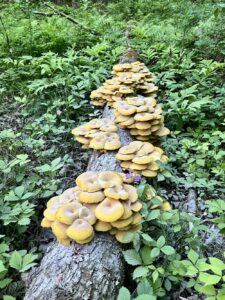
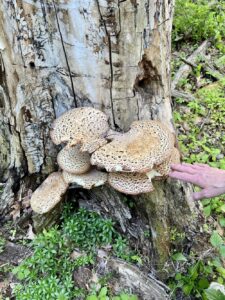
Golden Oyster Mushrooms

Greetings, fellow nature enthusiasts! Today, I want to celebrate the exhilarating experience of mushroom hunting. There’s something truly magical about venturing into the great outdoors, exploring hidden nooks, and stumbling upon these fascinating fungi. Let’s dive into the delightful world of mushroom foraging!

Mushroom hunting is like embarking on a treasure hunt, but instead of gold or jewels, you’re on the lookout for incredible fungal specimens. Armed with a bag of some sort and a keen eye, you embark on an adventure through forests, fields, and even your own backyard.

The thrill of the hunt lies in the unknown. Every step carries the potential to uncover a hidden gem. With each new find, excitement surges through your veins as you come face to face with a myriad of shapes, colors, and sizes. From the elegant and delicate to the whimsical and bizarre, mushrooms never cease to surprise.

As you venture deeper into the realm of mushroom hunting, you’ll discover that it’s not just about the mushrooms themselves but the journey they take you on. It’s an opportunity to connect with nature on a profound level, sharpening your observation skills and immersing yourself in the wonders of the natural world.

But remember, mushroom hunting requires caution and knowledge. Not all mushrooms are safe to eat, and some can be toxic or even deadly. It’s crucial to educate yourself, consult field guides, and learn from experienced foragers or mycologists. Safety should always be a top priority.

Beyond the thrill of discovery, mushroom hunting offers a chance to embrace tranquility and mindfulness. As you wander through the forest, the hustle and bustle of everyday life fade away, replaced by a sense of peace and harmony. Time seems to slow down, allowing you to fully immerse yourself in the beauty of nature.

Dryden’s Saddle Mushrooms

And let’s not forget the joy of culinary exploration. For those interested in edibles, discovering a trove of delectable mushrooms can awaken your inner chef. From sautéing them with butter and herbs to incorporating them into flavorful dishes, the possibilities are endless. But remember, only consume mushrooms that you are absolutely certain are safe for consumption.

So, fellow adventurers, grab your gear, put on your hiking boots, and set out on a mushroom-hunting escapade. Unleash your inner explorer, and let the thrill, wonder, and serenity of mushroom hunting captivate your senses.

Remember, respect nature, learn about the mushrooms you encounter, and enjoy the journey. Happy hunting, my fellow fungi aficionados!

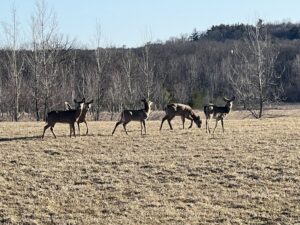
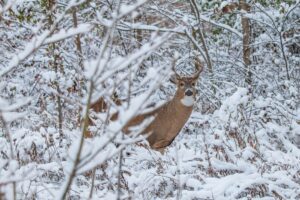
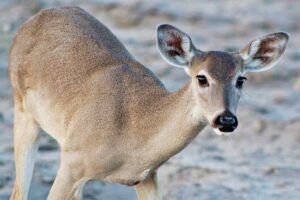
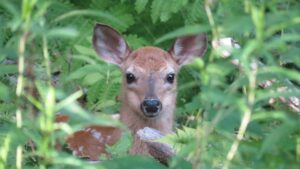
Whitetail Deer


We live in the Town of Bethlehem, New York, and our home is approximately 8 miles from downtown Albany, New York, the state capital. However, we live in a rural area surrounded by open fields and woods with just a few neighbors to the west of us.

Over the past few years, we have witnessed a growing herd of whitetail deer in our area. It Is not unusual for us to see 40-50 deer at a time feeding in the field next to our house. While we enjoy watching the deer, it seems to me that the deer population in our area is reaching an unsustainable level.

Whitetail deer are one of the most popular and sought-after game animals in North America. They are known for their elusive nature, graceful movements, and the thrill of the hunt. But whitetail deer are more than just game animals. They are an important part of the ecosystem, playing a critical role in maintaining a healthy balance in the forest.

Biology

Whitetail deer are members of the Cervidae family, which includes elk, moose, and caribou. They are medium-sized mammals, with males (bucks) weighing between 150 to 300 pounds and females (does) weighing between 90 to 200 pounds. Their fur varies from reddish-brown to grayish-brown, with a white belly and white on the throat and under the tail. Whitetail deer are named after their distinctive tail, which is white on the underside and can be raised like a flag when alarmed.

Whitetail deer are herbivores, feeding primarily on leaves, twigs, fruits, and acorns. They have four-chambered stomachs and a complex digestive system that allows them to extract nutrients from tough plant material. Whitetail deer are also known for their keen sense of smell and hearing, which helps them detect predators and avoid danger.

Behavior

Whitetail deer are social animals that live in family groups known as herds. Herds are usually composed of a doe, her offspring, and occasionally a few other females. Bucks are mostly solitary, except during the breeding season, known as the rut. During the rut, bucks compete for the attention of does, engaging in fierce battles and displaying dominance through various behaviors such as antler rattling and grunting.

Whitetail deer are active during the day, primarily in the early morning and late afternoon. They are crepuscular animals, meaning they are most active during twilight periods. Whitetail deer are also known for their ability to jump high and far, with some individuals able to clear fences up to 8 feet tall.

Habitat

Whitetail deer are found throughout North America, from southern Canada to northern South America. They are adaptable animals that can live in various habitats, including forests, grasslands, and swamps. However, they prefer habitats with a mix of forest and open areas, such as meadows and fields.

Whitetail deer are also known for their ability to thrive in suburban and urban areas. They have adapted to living near humans, often using parks and other green spaces as their habitat. However, this has also led to conflicts between deer and humans, such as vehicle collisions and damage to gardens and landscaping.

Conservation

Whitetail deer are an important part of the ecosystem, playing a critical role in maintaining a healthy balance in the forest. They are a food source for predators such as coyotes and mountain lions, and their grazing and browsing behavior helps maintain the health of the forest understory. However, whitetail deer populations can also become overabundant, causing damage to forests and crops.

The management of whitetail deer populations is a complex issue that requires balancing hunting and conservation efforts. Hunting is an important tool for managing deer populations, but it must be done in a sustainable and responsible manner. Conservation efforts such as habitat restoration, predator management, and population surveys can also help ensure the long-term health of whitetail deer populations.

Conclusion

Whitetail deer are a fascinating and important part of the North American ecosystem. They are adaptable animals that can thrive in various habitats, from forests to suburban areas. Their biology and behavior make them popular game animals. Still, they are also an important part of the ecosystem, playing a critical role in maintaining a healthy balance in the forest.

Whitetail deer have a complex social structure, with family groups and bucks competing for the attention of does during the breeding season. Their adaptability and ability to thrive in various habitats have also led to conflicts with humans, particularly in suburban and urban areas.

Conservation efforts such as responsible hunting, habitat restoration, and population surveys are essential for maintaining healthy whitetail deer populations. It is important to remember that while they may be popular game animals, they are also a vital part of the ecosystem and must be managed in a sustainable and responsible manner.

In conclusion, whitetail deer are a fascinating and important part of the North American ecosystem. Understanding their biology, behavior, and habitat is essential for managing their populations in a sustainable and responsible manner. Whether you are a hunter or enjoy observing these graceful animals in the wild, it is important to appreciate their role in maintaining the balance of nature.

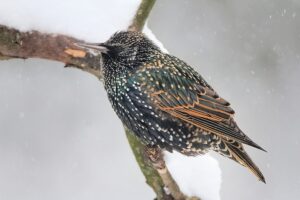
The European Starling

Someone recently posted a few beautiful pictures of a European Starling in our Nature of Things Facebook Group. The post on Facebook reminded me of an article I wrote back in 1995 for the magazine the United States Golf Association published. In the article, I contrasted the human attitude towards starlings to how we seem to feel about “garbage.” The bottom line is that starlings didn’t get to North America by themselves, and all the “garbage” that is filling up our landfills wasn’t created by itself either.

Many exotic and invasive species that we worry about, including the European starling was introduced by people. All of the “garbage” that continues to fill up landfills is also created by people. I guess it is just the nature of things.

Read the 1995 article by clicking The Trash Bird Article

A Flash of Red in a Field of White

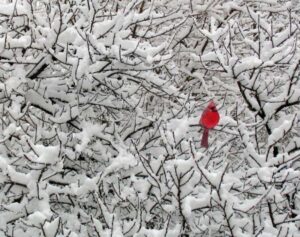
As I was sitting in my office, staring out the window during the blizzard we recently had, I noticed something beautiful in the midst of all the dreary winter weather. There, perched on a snow-covered shrub, was a stunning adult male cardinal.

It was as if the bird knew I needed a little pick-me-up on this gray day. Its bright red feathers stood out against the white snow, and the crest on top of its head added an extra touch of elegance. I couldn’t help but stop and watch the bird for a few moments, taking in its beauty.

Seeing the cardinal in its natural habitat was a reminder of how amazing nature can be, even amid a cold and dreary winter day. There are still little moments of beauty that can bring us a moment of joy.

As I watched the cardinal fly away, I couldn’t help but feel grateful for the little things in life that can bring us so much happiness. It’s important to take a moment to appreciate the beauty around us, even if it’s just a glimpse of a stunning bird through an office window.

So, if you’re feeling a little down today, look outside and see if you can spot something beautiful. Who knows, you’ll catch a glimpse of some beautiful birds too. It is the nature of things!

Oak Leaves in the Snow

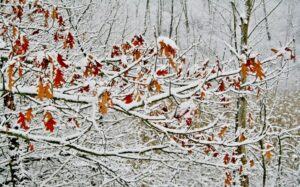
Walking on a crisp winter day, I came across a tree with snow-covered branches. The tree was barren, its branches stretching into the sky like spindly fingers. But as I looked closer, I noticed something strange. Despite the snow covering the tree, I could see the unmistakable shape of oak leaves still clinging to a few branches.

I couldn’t help but stop and admire the beauty of the scene. The snow was pristine white, and the oak leaves were a deep reddish-brown, standing out in stark contrast against the snow. The leaves were curled up and browned around the edges, but they still held their shape as if defying the cold and snow.

I wondered how the leaves had survived the winter thus far while the rest of the tree had shed its leaves and become bare. Perhaps these leaves had clung on tightly, sheltered by a particularly thick layer of snow, or perhaps they were simply hardier than the others.

As I continued my walk, I couldn’t stop thinking about those oak leaves. They reminded me of the resilience of nature and the beauty that can be found even in the midst of winter’s harshness. I felt grateful to have witnessed such a small but awe-inspiring moment. It reminded me to keep my eyes open for the unexpected and beautiful moments that nature can offer, even in the depths of winter. It is the nature of things.

Economic Benefits of Nature Preserves to Local Communities

Nature preserves, also known as wildlife sanctuaries or conservation areas, are protected areas of land that are set aside for the preservation and protection of natural ecosystems and wildlife. While many people may view nature preserves primarily as recreational areas or spaces for outdoor activities, they also provide a range of economic benefits to the surrounding communities.

One of the primary economic benefits of a nature preserve is the potential for ecotourism. Ecotourism refers to responsible travel to natural areas that conserves the environment and improves the well-being of local people. Nature preserves can attract visitors who are interested in exploring natural habitats and observing wildlife in their natural environments. These visitors often spend money on lodging, food, transportation, and other services in the surrounding communities. According to a report by The Nature Conservancy, ecotourism generates more than $77 billion in revenue annually worldwide.

Nature preserves also provide economic benefits to nearby communities through their role in maintaining environmental services. These services include regulating climate, purifying water and air, and preventing soil erosion. By protecting and maintaining natural ecosystems, nature preserves help to ensure that these services are available to the communities that depend on them. For example, a nature preserve may act as a natural filter for water that is used for drinking or irrigation in nearby communities.

Nature preserves can also have a positive impact on property values in nearby communities. Studies have shown that proximity to natural areas, including parks and nature preserves, can increase property values by as much as 20 percent. This is partly due to the aesthetic value of the natural environment and the appeal of living near green space.

In addition to these economic benefits, nature preserves provide various social and environmental benefits to communities. They can serve as educational resources, providing opportunities for schools and community groups to learn about and experience nature firsthand. Nature preserves can also help to protect biodiversity and prevent the extinction of species that are threatened by habitat loss or other factors.

In conclusion, nature preserves are valuable assets to the communities that surround them, providing a range of economic, social, and environmental benefits. By protecting and maintaining natural ecosystems, nature preserves help to ensure that these benefits are available for generations to come. It is important for communities to recognize and support the importance of nature preserves and their benefits.

IT’S THE NATURE OF THINGS!                  


Five Rivers Environmental Education Center

When we first moved to the Albany, NY area in 1982 I opened my first office in Delmar, NY because I believed that is where the NY Department of Environmental Conservation was located. It actually took me several months to figure out that the main headquarters of DEC was actually several miles north of Delmar in a large building on Wolf Road, Colonie, NY. However, the State Non-gave and endangered species offices and leadership were located in Delmar at what is now called the Five Rivers Environmental Education Center. Five Rivers is located just a few miles from our home. The DEC staff located at Five Rivers, became some of my closest friends and comrades during my 5 year stint working for the National Audubon Society in the Northeast.

Five Rivers Environmental Education Center is a living museum comprising over 450 acres of fields, forests, and wetlands. Located in the Capital District, the center provides a variety of easily accessible programs and services for individuals, families and organized groups. In recognition of outstanding interpretive programming, the National Park Service has designated Five Rivers a National Environmental Study Area.

There is a visitor center with interactive displays and exhibits, built in June 2017. Before heading out on the trails, a stop in the visitor center to learn about the habitats and wildlife of Five Rivers, our history, and the green features of the new building is a treat.

Over a century ago, much of the vicinity around what is now the Five Rivers was covered by extensive orchards. As the Great Depression took hold, many hard-scrabble farms could no longer make ends meet. In 1933, the New York State Conservation Department purchased two of these farms to develop the Delmar Experimental Game Farm. At the time, populations of upland game birds and waterfowl were in serious decline. The primary mission of the facility was to learn more about the propagation and management of these species.

From 1933-36, the Civilian Conservation Corps Camp S-72 put up buildings, fences and developed access roads throughout the property to prepare the site for game farming. CCC crews also created ponds by damming the Vlomankill, using limestone blocks salvaged from the abandoned Watervliet Lock of the old Erie Canal. In succeeding years, CCC crews created several additional duck-rearing ponds and erected several additional buildings for brooding, hatching and rearing upwards of 100,000 grouse and pheasant chicks per year. Each fall, the upland game birds and waterfowl were released on state lands throughout New York. The Canada geese that nest at Five Rivers today are thought to be descended from birds originally raised here.

In 1941, the Department established a Wildlife Research Center on site to expand on-going pathology studies, as well as to field test innovative theories in wildlife management. Techniques developed on site such as aging deer via dentition, perfecting the cannon-net and modeling wildlife populations via biometrics revolutionized the wildlife management profession nation-wide.

So as to re-direct increasing public interest away from the sensitive conservation research activities on site, in 1948 staff began developing a modest exhibition of caged wildlife in the area adjacent to the main parking lot. The menagerie came to be known far and wide as the Delmar Zoo, and firmly established the site as a vibrant educational institution. Tens of thousands of families and school group visited this remarkable collection annually. In 1970 there was a major reorganization of the Conservation Department, from which the current Department of Environmental Conservation emerged. As a result of this reorganization, priorities of the Department were reoriented and the Game Farm and Zoo were closed.

Because the site had become such an important community asset, a group of concerned citizens organized and successfully convinced the state to transform the abandoned site into an environmental education center. Thereupon, the Department developed a rustic amphitheater, a series of nature trails and refurbished a former sign shop as a Visitor Center. The new facility was opened to the public in June of 1972. It was renamed the Five Rivers Environmental Education Center, a name suggested by SUNY Albany meteorologist Dr. Vincent Schaefer, to denote the five rivers which comprise the watershed within the Center’s service area, namely the Hudson, Mohawk, Hoosic and Sacandaga rivers and the Schoharie Creek.

The Nature of Things – Here and There

Field Trips – It was another hot and dry week here in Upstate NY. But we did manage to get in a couple of short hikes and a couple of walks down the road and back. Most days in addition to the heat, the humidity has been very high too. We actually went to Hollyhock Hollow Sanctuary on 2 occasions last week, mostly to explore the dry creek bed. My office was at Hollyhock Hollow for 26 years and I don’t recall seeing the creek as dry as it is this year.


Nature-based Communities – I have fully launched my initiative that I call the Nature-based Communities Initiative, which is a campaign to get people in regions across the country to become more connected with nature and natural resource management. I’m focusing on 3 regions myself, one here in New York, one in Florida and one in Indiana. I’m trying to practice what I preach and then report on my personal efforts in hope that others in various regions around the United States might decide to take on similar actions where they live. Want to learn more CLICK HERE


Conservation Landscapes – This initiative is aimed at offering information that I hope is useful for landowner/managers who might care to manage their landscapes with nature and natural resources in mind. This site and blog is essentially a series of fact sheet type posts on various topics that provides information on landscape management for people to consider using where they live, work and play. To see an example: CLICK HERE


The Conservation Company – In an effort to keep items out of landfills and to generate money for conservation and environmental education project, I resell items on eBay. Sales have generally been slow, and as I have heard sales has been slow for most people who are resellers. So, I have just been listing, listing, listing, and reducing prices too. CLICK HERE for my latest update on my reselling efforts.


Letters from a Foxhole – This project is not directly connected with nature, but it is connected with my dad. I’ve continued to post a series of Letters that Dad wrote home to his sister during his time in the Army during World War 2. If that sounds like something that might interest, you CLICK HERE to see more.

New Year – New Goals!

A belated Happy New Year!

I spent the last month or so of 2021 thinking seriously about what I have been doing over the past few years and have come to the decision that I have not been doing the things that I really want to do. So…I am changing my focus and my direction. What I am actually doing is “re-focusing” on my life-long mission connected with nature conservation and to get more people involved with nature where they live, work, and play. With that, I also believe that we all must truly “Think Global and Act Local.”

So, to “think global” I have created the Natural Communities Campaign. The Ultimate goal is to protect 50% of the Earth by the year 2050 as protected areas and reverse the tremendous downward spiral we are witnessing at present in the loss of biodiversity. To learn more click: Half-Earth.

An interim goal for the Natural Communities Campaign is to support the global effort underway to secure the protection of biologically rich areas of Earth to the tune of 30% of the planet by the year 2030, which is being called the 30X30 Project. Through the Natural Communities Campaign website and blog, I will be providing ongoing information about global biodiversity matters and updates on progress being made regarding the 30X30 project.

To bring the 30X30 global goal down to a national and local level, I have launched an initiative called Conservation Landscapes for America. Through the Conservation Landscapes for America website and blog, I will be providing information about the 30X30 Project in the United States and well as supporting and showcasing government agencies, non-government agencies, and private landowners who are practicing conservation landscape management on the lands and waters that they are responsible for.


In addition to the biodiversity-related goals, another main goal is to get more people involved in nature and natural resource management where they live, work, and play. I hope that the information provided on the two websites mentioned above will become a “one-stop-shop” of sorts for information about nature, biodiversity efforts, resources that people can use to start or grow their own nature-based initiatives at home, in their communities, their counties, regions, etc.

Finally, this Nature of Things website and blog will be managed as a “portal” to the two other websites mentioned, but the Nature of Things blog will focus on my personal nature and biodiversity efforts in three local regions in the United States; the Capital Region of New York, the Tampa Bay Region of Florida and the Southwestern Region of Indiana.

Nature in a Cemetery

On Saturday, June 12, I decided to take a “nature walk” in a different sort of place and at the same time stop by for a “visit” with an old friend. Albany Rural Cemetery in Loudonville, NY, is just under 500 acres and was opened in the early 1800s. Today there are over 135,000 people buried in the cemetery, including one President of the United States, 34 members of Congress, 8 presidential cabinet members, 5 New York State Governors, and 55 mayors of the City of Albany.

My first stop, however, was at the gravesite of Robert and Leona Train Rienow. The Rienows lived for many years on a property called Hollyhock Hollow Farm in Selkirk, New York. Mrs. Rienow passed away just a year or so before we moved to New York State, so I never met her. But, I spent many hours visiting with and talking with Robert Rienow. Upon his passing, he donated the farm to me and the Audubon Society of New York State (ASNYS), and I renamed it Hollyhock Hollow Sanctuary. Upon my retirement from ASNYS, the organization decided that they no longer wanted to be stewards of the sanctuary and have since passed ownership to the Mohawk Hudson Land Conservancy. I spent over 26 years working out of the office at Hollyhock Hollow Sanctuary, and now I believe the sanctuary is in good hands for the long-term future.

The inscription below that is on the side of the Rienow mausoleum sums up nicely the Rienow reverence for nature.

Albany Rural Cemetery is a wonderful place to walk or ride a bike through. The cemetery is full of ancient grave markers that are real works of art. A huge number of stately old trees are scattered throughout. And several lovely streams traverse the property and are bordered by large swathes of forested areas.

Former U.S. President Chester A. Arthur and his family plot is one of the more famous burial locations to be found in the cemetery. By the worn paths up to the monument, his gravesite receives a steady stream of visitors.

Although our walk through the cemetery was a mix of the beauty of nature, quietness, and solitude, I am certain that during the spring and fall migration periods, Albany Rural Cemetery would be full of life with many species of migratory birds. I do believe that I will return and confirm that.

Have you ever strolled through a cemetery as part of a nature walk? As someone interested in family history, I have spent many hours walking in cemeteries. Some people find that a bit odd, but I think it is a great way to show respect for our ancestors while enjoying the sites and sounds of nature.